“My posts may contain affiliate links. If you make a purchase through one of my links, you won’t be charged more, however I may receive a small commission at no additional cost to you. This allows me to continue sharing free content and to create more items for you. I truly appreciate your support! To learn more here is my disclosure statement“

Gameschooling…that terminology was new to me this fall when I officially began our homeschool journey. As I was joining countless new homeschool groups on facebook, I came across a gameschooling group. It turned out to be one of my favorite groups that I’ve joined. I will put a disclaimer here, the facebook group has been costly to my wallet. If you are active on the group you will hear of countless new games and want them all! I now have a running game wishlist on amazon ready to go for whenever a holiday purchase is needed. I figured that since we play family games all the time I knew exactly what gameschooling was. Well, I didn’t full understand, but being a gaming family sure did aid in adding new games that have educational attributes.
When you hear of gameschooling, you might wonder what in the world are you talking about? I wasn’t too sure what it was either. We have always been a game family even before homeschooling. My oldest two love games and we take them with us when we go out just in case we have a chance to play! Seems silly, but when you have 20-40 minutes to kill, that Phase 10 or Skip Bo card set that stays in the car comes in handy! Now with my younger two, I keep Skip Bo Jr and Pizza in a travel bag ready to go.
Okay, back to what gameschooling is. Gameschooling is simply taking advantage of games that teach our children through play. Those games that you use to play for family game night simply for entertainment are most likely games that can be used for educational purposes. Most games focus on social skills: taking turns, being patient, not being a sore loser and more. As your learners grow, the games will be different and more challenging in other ways…using problem solving skills and needing creative thinking to be used for strategies.
For the younger crew, a lot of focus in those early years are the basic social skills of taking turns and learning that you won’t always win. But Pre-K through 1st graders need lots of practice with numbers-recognizing numbers, writing numbers, adding numbers and subtracting numbers and even simple color or shape recognition. They also need lots of practice with letters-review of the letters, what the letter sounds are, basic reading, etc.
I am working on two new posts devoted solely to math games and reading games that I hope to share soon. I’m currently deep in the trenches of teaching basic math and letters to my preschooler and pre-kindergartner. It’s super amazing to see how much learning can take place through playing a game. And the best part!? You don’t have to tell your learner you are doing schoolwork! Some days a few games is all that gets accomplished. And you know what? That’s okay! Lots of learning took place during that game time!
Recently I bought a few new games. Not even in the interest of “gameschooling” simply because I’m exhausted. Covid and winter blues have set in. We can’t socialize like normal, I miss my mom friends, I miss play dates. And I’m just entering into my second trimester with babe number six and exhaustion is still larking around. I made a next day amazon purchase and on my front porch the following day were the following games: travel perfection and froggy feeding fun. Let me tell you, these were the perfect games at the perfect time. We played for hours. And after playing, I saw how much learning had just taken place. So I, of course, had to document it! So here are the games I purchased and what skills we worked on with each.

Perfection: I knew that perfection would be perfect for my four year old. She has just gotten into puzzles and this timer just adds the right amount of suspense to make it a fun and challenging game. I went with the travel sized one, as I thought the full size would be too challenging. Spoiler Alert: it wasn’t too challenging! But the awesome part of this game…you can set the timer to whatever amount of time you want it to be. If your learner is still just learning to match shapes and being timed would be too challenging, don’t set the timer! One minute too long for your learner to match the shapes, cut the time in half to challenge your learner! This is what we ended up doing! I cut the time back to just over 15 seconds and she was hit or miss accomplishing matching the shapes in that short time span. Perfect challenge. Little sister, just turned three. wanted to give it a go. I thought to myself, why not, but there is no way she’ll be able to do it. Well, like most things, she proved me wrong. She matched all the shapes. Then she wanted the timer on. She also was able to match all the shapes within the one minute timer. So we slowly decreased her time. Then the girls took turns matching the shapes and racing the timer. Over thirty minutes and they were still playing this game! Total win and totally counted as 30 minutes of learning!
Trouble-Honestly, this next game I was a little reluctant to purchase because I remember it not being fun as a child. But how well do you remember your 5 year old childhood!? So, I decided to give it a shot! I did an order pick up for target and had trouble in hand within an hour (we do live only a few minutes away from target). This game is so easy and basic that it was perfect for my three year old to join in without a long list of rules. Everyone picked a color to be. I also played along side them, I mean they can’t have all the fun, right!? Everyone lined their pegs into the home spaces. We took turns pushing the dome that rolled the die and moved as allowed. Two rules were all that I found: When you roll a 1, everyone else can move a peg from home into start if they are able to (except the one that rolled it) and when you roll a 6, you can either move a peg from home to start if able to or move six spaces then roll again. The fun thing about these rules are, they can be tweaked. My little ones are young, not being able to move from home to start when they are the one who rolled the one can be confusing, so you can tweak that rule if needed. If you have older children, add some twists to the game, like if you roll a three go back one. Or if you roll a two skip a turn. As the game is already created, it works on the basic social skills of taking turns, being patient and not being a sore loser or a boastful winner. If you add more in-depth rules, you are spiking a joyful curiosity into your learning. They can dive into game creation which triggers creative thinking and problem solving strategies both in play and in the rule creation.
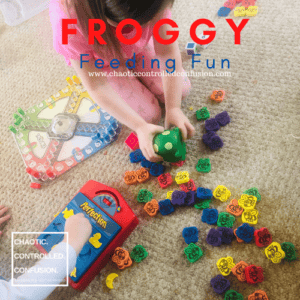
Froggy Feeding Fun-I intentionally picked an educational game for my three year old because I feel like she is lacking in attention both in general and in the educational sense. We also seldom purchase games just for her. Froggy Feeding Fun actually set in my amazon cart for almost a year. Well, I finally pulled the trigger and I wish I had so much sooner! This game focuses on all the things young children need practice with. Colors and number recognition. She has her colors down, but you can’t over kill color review at this age. You roll the die to see what color flies your frog will be picking up. You then roll another die to see how many flies to pick up. Now is the part that works those fine motor skills. Their little hand has to hold on to the frog, squeezing his cheeks to open his mouth and then release it to close on each individual fly. Now this is the most perfect game for working on these skills. You will find a lot of activities that work fine motor skills, their grasping/pincher hand hold, which is needed in writing, but you won’t find many games that work those fine motor skills. This game is top of my list for this purpose. To my surprise, my four year old took the reins of this game. She loved it! And she struggled to hold the frog in her hand and pinch his cheeks open, so this can only mean one thing: her hand muscles need more practice with this particular skill. I’m ecstatic that she loves the game. And I know from her interest, it will spark curiosity and desire for my three year old to play as well. They can take turns rolling both the color and number die and using the frog to pick up the flies. And this is a great independent game they can do when I’m not able to sit right with them. Independent and cooperative play makes a winning game for me!
As you can see from my few examples, that you probably already have some games on hand that you can change your mindset of “entertainment” to “educational” play time easily! And when you need a break or your kids just aren’t feeling “schoolwork” bring out the games. Not only will it count as schooling, but in our house, it normally sets the day for a much better mood for everyone!
What new games are you playing? Is there a way to incorporate games you already have into your school day? Or for added enrichment in the evenings or weekends if you aren’t homeschooling? I’d love to hear! Leave a comment for me!